
The Civic Consequences of Local News Deserts

Samantha Madsen
School of Media and Public Affairs, George Washington University
SMPA 2152: Data Analysis for Journalism and Political Communication
Ethan Porter
December 14, 2025
Local journalism has long been understood as a central pillar of democratic life in the United States, providing citizens with coverage of local elections, civic engagement opportunities, and community events. Local news has historically facilitated accountability and participation by lowering the barriers to accessing reputable information. However, over the past few decades, economic pressures, media consolidation, and the rise of new digital media platforms has made it increasingly difficult for local news outlets to survive, producing what scholars call “news deserts” — communities with little or no access to the vital institution of local news. Scholars and journalists alike have warned that these news deserts may have consequences, weakening civic engagement by limiting citizens’ ability to access the information necessary for political participation. While prior research demonstrates that local news promotes civic engagement, this study examines county-level voter turnout in the context of the 2020 election, accounting for demographic controls and highlighting potential complexities introduced by digital news proliferation.
A large body of research studies the critical role that local journalism plays in democratic life. More specifically, these institutions increase political knowledge, increase the likelihood that public officials are held accountable, and facilitate methods of civic engagement by connecting people to issues that directly impact their own communities (Hayes & Lawless, 2015). When local outlets become few and far between, citizens are less informed, less trusting of institutions, political or otherwise, and ultimately are less likely to turnout to vote in elections. National news trends are compounding this issue as the increasingly fragmented nature of widespread news programs are allowing national and digital news platforms to push local news out of its once significant civic functions (Bennett & Livingston, 2018).
Despite growing concern surrounding expanding news deserts, the empirical relationship between local news availability and election turnout is still pretty contested. Some studies, like those referenced above, discuss how loss of local newspapers reduces turnout and civic engagement, however, some studies point out that the proliferation of digital news sources creates an entirely different ball game, complicating an already complex relationship. This project aims to explore whether counties with fewer local news outlets exhibit systematically lower voter turnout than those with more robust local news ecosystems.
My hypothesis is that counties with fewer local news outlets will experience lower voter turnout than those with more access to local outlets. This is grounded in multiple political and social theories. First, research on political accountability demonstrates that local news can increase voter participation by lowering the cost, monetarily and mentally, of accessing information and monitoring elected officials (Snyder & Strömberg, 2010). Second, studies of civic engagement found that institutions—including local news—were vital in maintaining the norms and willingness of citizens to participate in many aspects of society (Putnam, 2000). Third, studies on media fragmentation suggest that when local news networks weaken, citizens may disengage from local politics in favor of more national or entertainment oriented broadcasts (Prior 2007).
To test this hypothesis, I conducted a cross-sectional analysis of U.S. counties combining data from many sources into a new dataset. Data on local news outlets was found from the The University of North Carolina at Chapel Hill’s News Deserts database, which provides comprehensive, county level information on all active news organizations in the United States. I found voter turnout data from the National Neighborhood Data Archive (NaNDA). Additional demographic data to use as controls, including median income, age and gender levels were found from the U.S. Census Bureau’s American Community Survey. The primary independent variable was access to local news, operationalized as a count of active news sources. The dependent variable was voter turnout, operationalized as the percent of eligible voters that cast a ballot in the 2020 general election.
To manage the datasets I had to make sure they all labeled counties identically. To do this I used standardized Federal Information Processing Standards (FIPS) codes, which are five digit codes ensuring that each county has an individual ID number and won’t be confused with a similarly-named county in another state. Additionally I filtered all the datasets to the year 2020 to get a better cross-sectional look at the country. Because the analysis only focuses on one election year (2020) the dataset captures variations across counties not changes over time. This design allows comparison between counties with different local news environments while holding potential effects of time constant. Lastly, I found it impossible to distinguish if a county had missing news data or no news stations in the county, which may have caused a flaw in my regression, but I got rid of as many irregularities as I could by excluding counties with missing voter turnout information to help insure consistency and that a number of counties wouldn’t become outliers incorrectly having 0% voter turnout.
The model I used was a multivariate ordinary least squares (OLS) regression with voter turnout as the dependent variable, regressed on the number of news outlets and other control variables (income, median age, gender breakdown, etc.). This analysis would not be able to determine causality as there is no way to randomly apply treatments to different counties. There is also no way to rule out reverse causality, such as politically active counties supporting more local newspapers, or potentially omitting an important control variable, consequentially, the results will only establish a correlation between the variables, not a causal relationship.
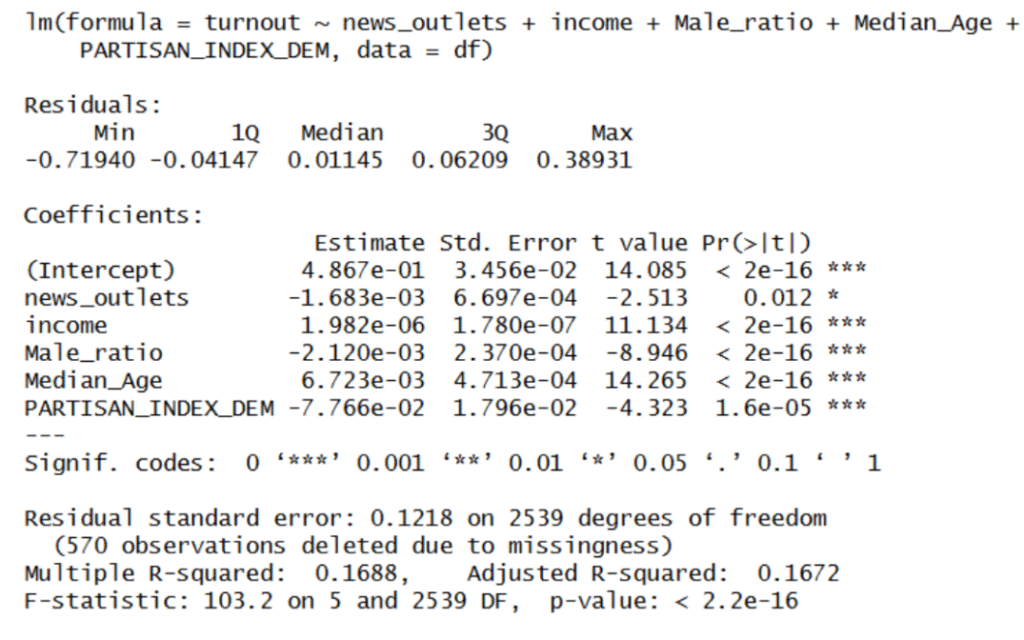
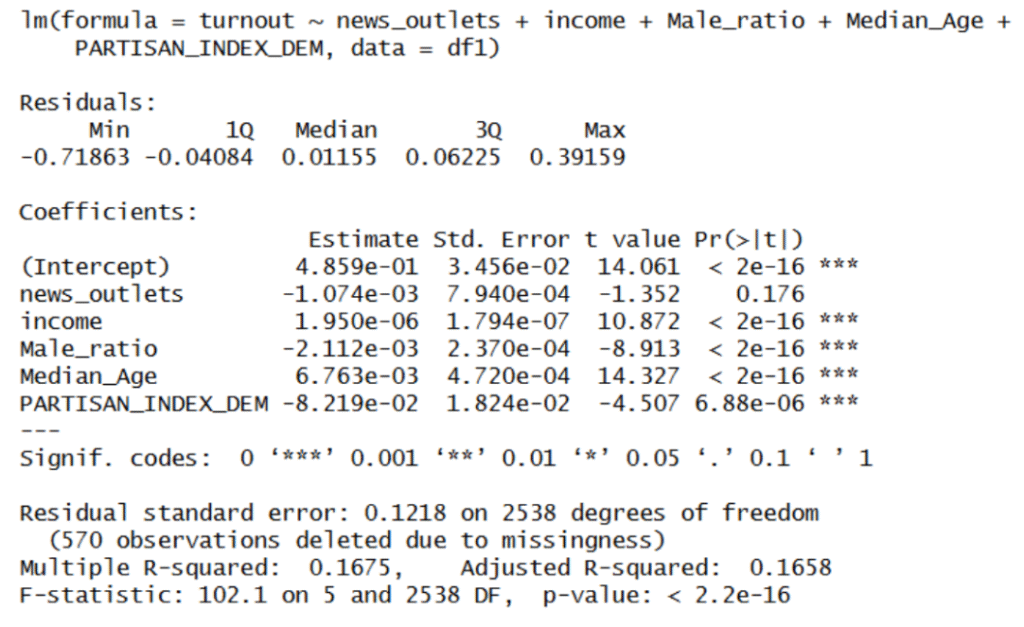
When I ran the regression, the model indicated a statistically significant relationship between the number of news outlets and voter turnout, however, contrary to my original hypothesis the coefficient for news outlets was negative, suggesting that counties with more news outlets have slightly lower voter turnout rates, holding the demographic control variables constant. I also noticed that there was one outlier county in Chicago which had over twice as many news outlets as any other county and had decently low voter turnout. I ran a regression only excluding this county and discovered that the relationship was no longer statistically significant, maybe pointing towards an outsized impact from a few counties on the rest of the data.
With Cook County, IL
Without Cook County, IL
While academic consensus has typically found that local news increased civic participation for some time, newer research papers are offering alternative explanations for lower voter turnout that may more closely align with the relationship found in this data. In Platforms, Politics, and the Crisis of Democracy: Connective Action and the Rise of Illiberalism Bennet and Livingston discuss the idea that extremist “digital surrogate organizations” appear as chaotic successors to mainstream outlets like FOX News or the Koch network. These organizations, such as Q Anon or Moms For Liberty spread misinformation, fracture trust in government, and push traditional outlets further to the right, alienating centrist voters. Bennet and Livingston argue that the collapse of democracy will not be brought about by the disappearance of traditional and local press institutions but by the erasure of “distancing capacity,” or the ability of these organizations to separate themselves from far more extremist views. Under this theory, it may make more sense for the counties with more outlets to face lower voter turnout if many of these outlets have been hijacked by more extreme digital surrogate organizations. In recent years there has been more discourse on the link between media and politics, however, especially with our rapid pace of technological advancement, no one has settled on a definitive answer.
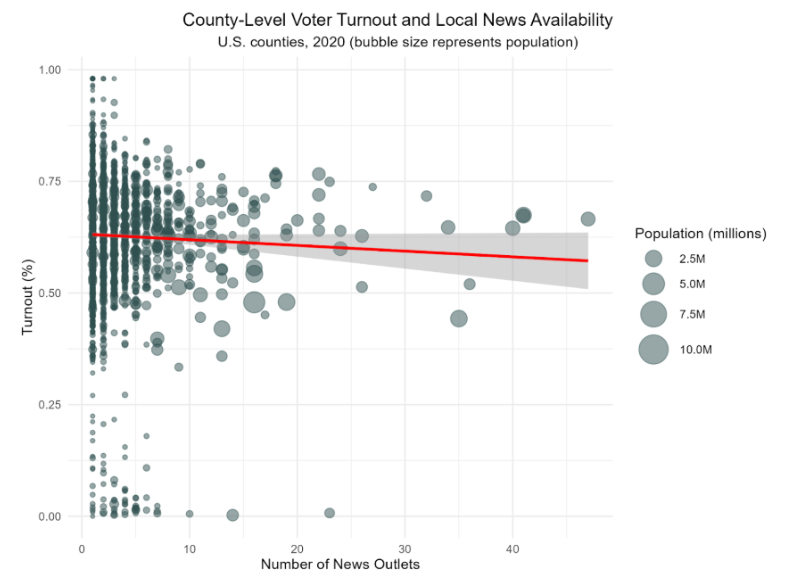
This graph represents the relationship between turnout and news coverage visually. The dots each represent a county and their size is adjusted for population. The red line is a representation of the regression model, and you can see the slight negative slope, although the confidence intervals are decently wide towards the right. This unexpected negative relationship may reflect the influence of fragmented digital news ecosystems, as suggested by Bennett & Livingston, rather than a straightforward decline in civic engagement. You can see that there are some irregularities in the data, especially with the cluster of dots around zero percent voter turnout, but overall I found this graph to be helpful in understanding the relationship and the amount of small counties that have little to no local news coverage.
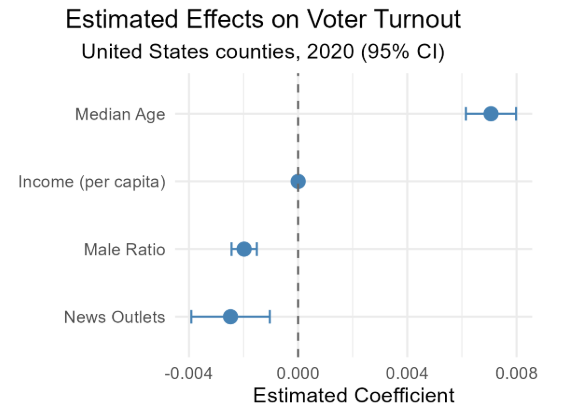
This graph showcases the confidence intervals of multiple independent variables in comparison to voter turnout. Although they aren’t all on the same scale, it is interesting to see which ones fall on which side of the line, potentially indicating other bigger factors at play than a lack of local news coverage. It showcases that simply increasing the number of news outlets in a region will not necessarily have the desired effect, but that we should look beyond to other factors and more heavily consider the quality of reporting.
The results complicate the theories I based my original hypothesis on. Rather than confirming the straightforward positive response between local news availability and turnout, my hypothesis receives mixed support. On one hand, there is a statistically significant relationship between the variables, however, the direction of that relationship challenges expectations. This indicates that the decline in local news may not uniformly dampen voter turnout, and that the number of outlets alone may be an insufficient measure of actual access to local news. This opens the floor to mention the limitations of this research design. Operationalizing “access to news” is difficult, and just using the number of outlets in each county is likely insufficient. For one, news outlets don’t just circulate in one county and their headquarters may not represent every county where their information is available. Another issue is treating every news source as equivalent regardless of quality, reach, or political relevance. Additionally looking at only one year doesn’t allow us to see the effect of outlet closures over time. Finally, just looking at general election turnout isn’t very specific to local political participation, as even people who just watch national news will still be exposed to information about a presidential election.
These issues don’t invalidate the findings, but are instead room for improvement in future research on the subject. Using a more longitudinal research design or doing specific case studies of counties with large numbers of closures could be helpful in indicating a result over time that isn’t captured in a cross-sectional design. Additionally looking at election turnout in local races would help indicate if the relationship is different for events that likely wouldn’t be covered by national or digital news surrogates.
Overall this information contributes to ongoing debates about the true effect of the decline of local news, the prevalence of newer forms of digital media, and how those can affect people’s willingness to participate in democracy. The results of this empirical examination suggest that the relationship between local journalism and civic engagement is far more complex than assumed and may depend on broader media-system dynamics rather than quantity alone. Understanding how our information environments shape democratic behavior is still a critical task for scholars of politics and media alike as we attempt to realize just how interconnected the world around us really is.