
I’ll Be There: The Disappearance of “We” in Neoliberal Democracies
Samantha Madsen
School of Media and Public Affairs, George Washington University
SMPA 2102: Intro to Political Communication
Steven Livingston
April 11, 2025
The digital age has enabled new forms of civic participation where online networks have hollowed out American democracy through the slow erosion of public trust, civic identity, and shared purpose. However, the weakening of civic life is not simply a cultural failure—it is the predictable outcome of structural changes in the economy, media, and political institutions. This section explores how these forces have contributed to the fragmentation of civic life and the rise of illiberal movements. First by examining how decades of neoliberal economic policy—beginning with Reagan and solidified under Clinton—dismantled collective structures and normalized individualism, weakening the material basis for civic participation. Second, considering how economic pain and disillusionment in places like Flint, Michigan have created powder kegs for moral detachment and resentment, especially as elite narratives continue to shift blame away from systemic failure. Finally, the paper turns to the rise of digital surrogate organizations—networked movements that mimic community but often undermine democratic norms—to show how a lack of distancing capacity is making political parties increasingly susceptible to extremist viewpoints. Together, these dynamics reveal not just a loss of trust, but a fundamental recasting of what it means to belong in American Democracy.
Community in Decline
As Robert Putnam noted in Bowling Alone, Americans are increasingly detached from civil society, with declining rates of union membership, church attendance, and participation in local associations. He laments the breakdown of “social capital,” identifying a loss of civic engagement and interpersonal trust as central to the weakening of democracy (Putnam, 1995). Putnam views civic involvement as the connective tissue that holds together democracy and explains that its erasure signifies a shift towards individualism, distrust, and disengagement. Yet Putnam’s analysis treats this crisis primarily as a cultural or moral decline, largely omitting the economic structures that helped produce it. In his later works, Putnam revises this flawed view. In his book The Upswing: How America Came Together a Century Ago and How We Can Do It Again, and in a 2024 interview with Lulu Garcia-Navarro, he acknowledges that economic stratification might be more central to the story than he initially thought (Garcia-Navarro, 2024).
“During the mid-20th century, the peak of the “We” society, America witnessed unprecedented economic prosperity and the flourishing of the middle class. This period was also marked by bipartisan political cooperation, strong social capital, and robust community networks. However, starting around the 1970s, various forces began to erode this sense of collective well-being, pulling the nation back towards an “I” society. Economic policies that favored deregulation, tax cuts for the wealthy, and the weakening of labor unions contributed to growing economic inequality. Concurrently, political polarization intensified, social cohesion weakened, and cultural narratives increasingly celebrated individual achievement over collective good” (Putnam, 2020).
This represents a significant shift toward exploring the idea that economic systems shape moral reasoning, not the other way around. However, this insight remains underdeveloped in his broader theory, which still tends to frame civic decay as a technocentric phenomenon. By focusing on changes in attitudes and social habits, he overlooked how the collapse of the welfare state, the decline of organized labor, and the deregulation of media ecosystems have systematically undermined the material conditions that once supported traditional civic life.
Selling Off Solidarity
The roots of this erosion trace back to the rise of neoliberalism in the 1970-80s—a political-economic system that pushed for deregulation, privatization, and an emphasis on personal responsibility over collective identity. As Stephan Metcalf argues, neoliberalism “swallowed the world” by recasting the citizen as a consumer and the state as a laissez-faire facilitator of market freedoms rather than a guarantor of shared goods (Metcalf, 2017). Ronald Reagan’s assault on labor unions and social programs marked a turning point, but it was under Bill Clinton, through policies like the repeal of the Glass-Steagall Act and welfare reform, that neoliberalism became bipartisan reality. Aldo Madariaga notes that this ideological shift has always posed a threat to democracy by undermining the conditions that sustain political equality and collective agency. He notes that “neoliberalism isn’t dying but is instead undergoing important transformations that make it especially dangerous for today’s democracy” (Madariaga, 2021). In this context, civic disengagement is not an accident but a feature of a system that devalues public life.
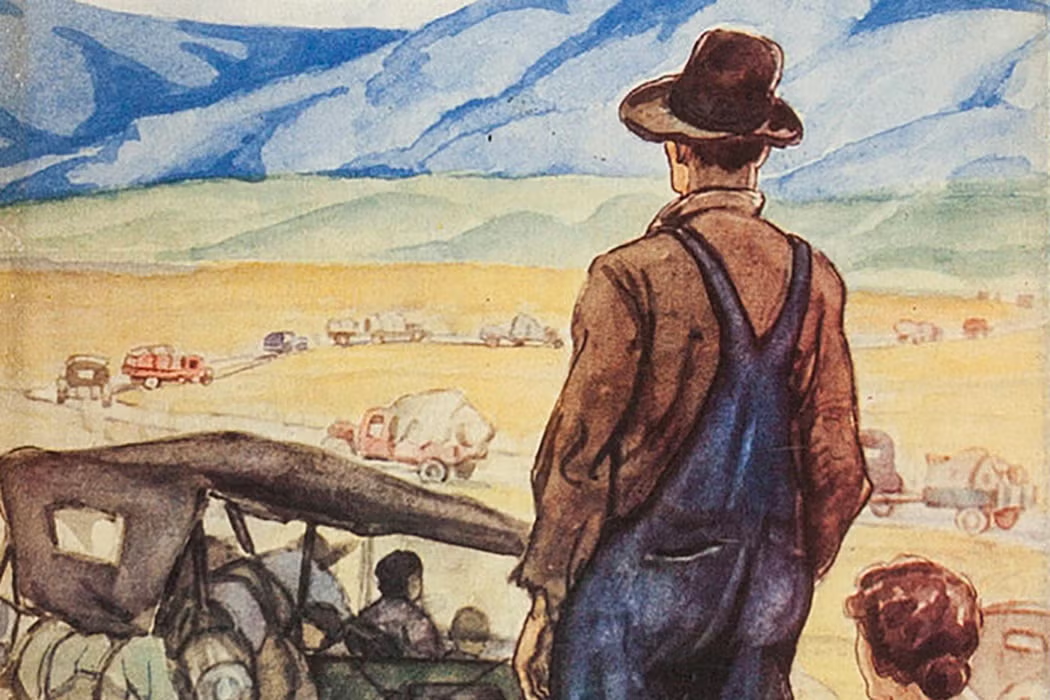
The consequences of this have been profound. As Bennett and Livingston explain in A Brief History of the Disinformation Age, neoliberalism not only destabilized economic security but also produced a moral vacuum in which traditional civic identities struggle to survive. The shift toward individualized responsibility fragmented social solidarity, eroding the narratives and institutional anchors that once supported civic participation. Civic life cannot flourish when citizens are isolated by economic precarity, distrustful of institutions, and encouraged to view politics through the lens of personal choice rather than collective struggle. In this climate, not only are traditional forms of engagement weakened, but the emotional infrastructure of solidarity begins to vanish. And yet, the idea of collective belonging—that people are bound together by more than self-interest—has always been central to democratic resilience. Nowhere is this more clearly expressed than in Tom Joad’s monologue from The Grapes of Wrath.
“Well, maybe like Casey says, a fella ain’t got a soul of his own, but only a piece of a big one… Then it don’t matter. Then I’ll be all around in the dark. I’ll be everywhere — wherever you look. Wherever there’s a fight so hungry people can eat, I’ll be there. Wherever there’s a cop beating up a guy, I’ll be there. If Casy knew, why, I’ll be in the way guys yell when they’re mad and — I’ll be in the way kids laugh when they’re hungry and they know supper’s ready. And when our folks eat the stuff they raise and live in the houses they build–why, I’ll be there” (Steinbeck, 1939).
This is a vision of democracy as a mutual obligation and a faith in the shared soul of the public. But in towns like Flint, Michigan, where poisoned water and shuttered factories have become the marker of national identification, that faith is harder to justify. What happens when the systems that once allowed people to “eat the stuff they raise and live in the houses they build” are dismantled by decades of economic abandonment and subsequently blamed on lack of personal character? What emerges, then, is not just a loss of trust in government—as evidenced by historic lows in public confidence reported by the Pew Research Center—but a transformation in how people relate to each other and the democratic system itself.
Civic Life in the Age of the Algorithm
If neoliberalism fractured the material and social foundation of civic life, the digital age has reassembled its pieces into a very different, and often dangerous, configuration. The decline of traditional civic institutions has not led to the disappearance of public action; instead, it has created space for new forms of political participation that often undermine the very norms they claim to revive. While earlier scholars like Robert Putnam lament the loss of civic associations as a kind of democratic decline, Nancy Bermeo offers a significant revision: not all civil societies are good. Some civic associations can lead directly to democratic decline. In her analysis of democratic breakdowns, Bermeo introduces the concept of “distancing capacity,” or the ability of mainstream parties and institutions to keep extremist or anti-democratic ideas at bay. When that capacity erodes—often during moments of economic despair and political disillusionment—democracies become too porous. In these moments, Bermeo warns, civil society becomes a double-edged sword, allowing far right or illiberal organizations to slip into the mainstream under the false guise of grassroots mobilization. In short, civic life does not disappear under technocratic neoliberalism, it mutates into something more sinister.
This mutation is best captured by Lance Bennett and Alexandra Segerberg, who argue that the age of collective action has given way to the logic of connective action. In this new paradigm, organizing does not rely on long-standing, physical institutions like unions, churches, or party organizations. Instead, it unfolds through personalized ‘action frames’ shared across digital networks. Movements like Occupy Wall Street or Stop the Steal do not require formal leadership or coherent ideology; they thrive on emotional resonance, rapid coordination, and shared affect.
“Whether we look at PPF, Arab Spring, the indignados, or Occupy, we note surprising success in communicating simple political messages directly to outside publics using common digital technologies such as Facebook or Twitter. Those media feeds are often picked up as news sources by conventional journalism organizations. In addition, these digitally mediated action networks often seem to be accorded higher levels of [worthiness, embodied by the endorsements by some 160 prominent civil society organizations,] than their more conventional social movement counterparts” (Bennett, Segerberg, 2013).
Technology flattens institutional hierarchy and lowers the barriers to participation, but at a cost. These movements lack institutional memory, accountability, and the ability to sustain durable change. In this sense, connective action mimics the form of solidarity without its function. It allows people to feel politically engaged without necessarily building anything capable of enduring beyond the moment.
This phenomenon takes on an even more urgent tone in Lance Bennett and Steven Livingston’s work, Platforms, Politics, and the Crisis of Democracy, where they argue that digital surrogate organizations have emerged as powerful but volatile actors in contemporary politics. These groups, such as Q-Anon, anti-vaccine networks, or Moms for Liberty, are crowd-sourced, fast-growing, and emotionally potent. They are not formally affiliated with political parties, but they provide those parties, especially on the right, with a powerful means of mobilization. In doing so, they play a key role in what Ziblatt calls the “conservative dilemma”: the challenge of winning mass electoral support without threatening the interests of the elite capital-holding constituents whom the party serve. Digital surrogate organizations help solve this problem by pushing ‘cross-cutting cleavage issues’—culture war flashpoints that divide working-class voters against each other and distract from systemic economic inequalities. Issues like critical race theory, trans rights, parental control over education, and COVID-era government mandates become not just policy debates, but litmus tests of personal identity and moral belonging. The brilliance, and danger, of this strategy lies in its capacity to displace class solidarity with affective politics rooted in fear, resentment, and tribal loyalty. As a result, these surrogates do not just energize the base; they reshape it, recasting what political engagement looks and feels like.
This strategy did not emerge in a vacuum. It builds on decades of infrastructure laid by elite funders like the Koch network, which has spent billions cultivating a political ecosystem that merges libertarian economics with social conservatism. Initially focused on dismantling regulatory and redistributive policies, the Koch network expanded its influence through think tanks, dark money channels, and grassroots movements like the Tea Party. These efforts paved the way for today’s surrogate organizations by priming a public sphere steeped in anti-government sentiment, individualist ideology, and cultural grievance. In many ways, digital surrogates are the chaotic heirs of this project—deeply aligned with its goal of keeping the working class divided and distracted while elite interests remain protected. Unlike traditional interest groups, these surrogate organizations cannot be easily controlled, moderated, or distanced from. They collapse the institutional guardrails that once kept illiberalism at the margins of acceptable society.
“Networking these radical factions not only brings more extreme voters and candidates into the party, but also creates a pull for more conventional party surrogates to become more extreme, as in the case of election denial conspiracies on Fox News, or the shifting center of gravity among Christian nationalist surrogates toward the creation of a religious state. As a result, party boundaries became far more “porous”—that is to say, the party is unable to maintain clear boundaries between it and its surrogates” (Bennett, Livingston, 2025).
Bennett and Livingston go further, urging scholars and citizens alike to move beyond a technocentric view that blames algorithms, echo chambers, or disinformation alone. They argue instead that digital politics has become a kind of secular religion—a space where people go not merely to get informed, but to experience meaning, identity, and belonging in a world that feels increasingly uncertain. As Bermeo might put it, the distancing capacity of democracy has not simply weakened, it has been outsourced. What emerges in its place are affective publics fueled by outrage and nostalgia, loyalty and grievance—movements that are less about policy than they are about identity. They are fast, flexible, and deeply resonant, but they are also corrosive. They do not offer a pathway back to civic renewal, but instead, accelerate the fragmentation of democratic life into ever-smaller echo chambers of emotional affirmation.
Conclusions
The erosion of American civic life is not merely the result of cultural drift, moral failure, or a lack of individual engagement. It is the outcome of structural transformations in the economy, media, and political institutions that have slowly unraveled the material and social basis for collective life. Neoliberal economic policy normalized competition over cooperation, disinvested in public goods, and redefined citizenship as a matter of market participation rather than democratic belonging. The pain of this disinvestment—felt most acutely in deindustrialized towns like Flint, Michigan—has fostered alienation, resentment, and a turn toward affective, symbolic politics. As traditional civic organizations faltered, digital platforms offered an alluring substitute: fast, flexible, emotionally resonant forms of engagement that promised belonging but often delivered fragmentation and distortion.
Through the lens of Bermeo’s “distancing capacity,” we can see how the weakening of institutional buffers has enabled extremist movements to infiltrate mainstream politics. Bennett and Segerberg’s theory of connective action shows how political engagement has been reshaped by digital networks, shifting power away from organized institutions and toward loosely affiliated publics united more by emotion than strategy. And Bennett and Livingston’s concept of digital surrogate organizations reveals the deeper danger: that our public sphere is being repopulated not with renewed civic associations, but with decentralized movements that operate outside the norms and constraints of liberal democracy.
While the erosion of civic life is significant in the United States, other countries provide valuable examples of democratic renewal, showing how digital platforms can strengthen civic engagement when integrated with robust institutional frameworks. In Spain, the Barcelona en Comú movement, born out of the indignados protests, redefined local governance by using digital tools to deepen citizen participation in decision-making processes. Rather than bypassing traditional institutions, this initiative focused on using technology to enhance public involvement in areas like budgeting, housing policy, and urban development. Similarly, Iceland’s crowdsourced constitutional reform process after the 2008 financial crisis demonstrated the potential for transparency and collective authorship, even if it was ultimately obstructed by political elites. These examples illustrate that digital tools, when embedded within strong civic infrastructure, can bolster democratic agency and inclusivity. The real issue lies not with technology itself but with its alignment with neoliberal values that prioritize short-term gains over long-term democratic health. Where civic life remains strong, digital tools can serve as a force for renewal rather than division.
To understand this neoliberal crisis means you must reject the comforting fiction that democracy can be repaired solely by better messaging, more participation, or a return to civility. The fragmentation of civic life is not an accident—it is the result of systemic forces that hollowed out the structures of solidarity while offering in their place a politics of spectacle, identity, and blame. Yet even in this fractured landscape, there are embers of democratic possibility. The same digital tools that enable disinformation and rage can also support solidarity and resistance—if they are embedded within institutional strategies that prioritize justice, inclusion, and shared purpose. Any serious democratic renewal must begin not by mourning the loss of a mythic past, but by confronting the structures that made its collapse inevitable—and imagining new ones in their place.